Friday, 2 August 2013

Blankets.


I once heard the artist Peter Howson say that the most significant artistic development in the twentieth century was the graphic novel.  Whether this is true or not it is certainly the case that comics (which is what we used to call graphic novels) have come a long way in the last fifty or so years.  

One of my primary school teachers whenever she found a comic in your desk would pick it up by the tips of her thumb and forefinger, display it before the class with a look of intense disgust, and then drop it in the bin.  The message was that this object was not just disagreeable it was actually harmful.  The UK parliament of 1955 apparently agreed, to some extent at least.  The Home Secretary of the time, Gwilym Lloyd George, introduced The Children’s and Young Persons (Harmful Publications) Act 1955 in response to concerns expressed by teachers and clergy at the possible effects of horror comics on children.  The real issue was the amount of violence and cruelty and ‘incidents of a repulsive or horrible nature’ which were depicted but it is fair to say that comics in general were not regarded as a good thing.  

Now graphic novels are regularly reviewed in the Guardian and the New York Times, and are written by the likes of Ian Rankin, Denis Mina and Neil Gaiman.  The comic is no longer part of the junk heap of our culture.  Anyone in any doubt about this should read Craig Thompson’s ‘Blankets’.  This is a tour de force of 582 pages which Thompson has drawn as well as scripted.  It is a story of love and its loss and faith and its loss conveyed in a way which would not be possible with words alone.  It manages to be poignant and funny but sometimes disturbing.  This is one of the problems with the graphic novel.  It is capable of dealing with serious, ‘adult‘ issues but anything with pictures is always going to be attractive to children.  As with films, books, TV programs, there are some graphic novels that are decidedly not suitable for children.  But there is no doubt that the genre has produced much to be valued and much that will endure.    

Monday, 24 June 2013

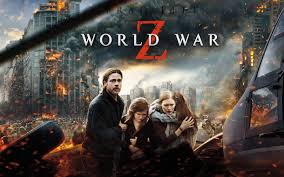
World War Z


Now I wouldn’t normally be drawn to a zombie movie.  Honest.  But this is the Glasgow Zombie Movie , the one where George Square and its environs were used to film scenes of violence, mayhem and panic.  So a bit of a disconnect there, but apparently in the time the film-makers were there millions and millions and millions were poured into the local economy, and locals got to play the part of the zombies.  We’ve heard all the jokes about that so let’s get on with the film.

It’s actually very good.  For some reason, and we are never told why, millions of people have been infected with a virus which is passed on by biting.  They are uncontrollably aggressive and are capable of overcoming the best efforts of armies all over the world.    It largely avoids the ‘yuk’ factor so prominent in most zombie movies and brings a heightened sense of the helplessness of humanity when faced with nature at its most red in tooth and claw.  

At one point a scientist likens nature to a serial killer who has a powerful urge to get caught, and at her strongest sometimes reveals where she is most weak.  Whether this happens, you will have to find out yourself.  

Brad Pitt is great as Gerry Lane, no Man Of Steel, but courageous, sensitive and insightful.  There are no other big name stars but they all work together to produce a tense, quality entertainment.  

Tuesday, 18 June 2013

Man Of Steel


The Glasgow premiere of the first Christopher Reeve ‘Superman’ movie was on a Thursday night in 1978 at the Regal Cinema in Sauchiehall Street.  I was there with my wife of three months.  We cheered - at least I did - when Clark Kent  ripped open his shirt to reveal the famous ‘S’; we chuckled - at least I got the joke - when he decided not to get changed in a perspex telephone booth; and our hearts soared - and I think the ‘we’ is appropriate this time - with John Williams’ majestic music.

And here lies the problem with this attempt to tell the old story in a new way.  It just doesn’t touch you at any level.  It was a good idea to tell something of the Krypton back-story and the circumstances which bring Kal-El to the earth but it goes on too long.  We learn about Clark’s early life in flashback and the problems he had coming to terms with his special powers and his alien identity.  This was promising but we didn’t get enough of it.   What we get more than enough of for the last third of the film are migraine-inducing special effects: buildings imploding and exploding, roads being ploughed up, fearsome weapons bringing death and destruction.  I was glad I went to the 2-D version.   

No cheers, no chuckles, no triumphal chords.  One thing though.  From my first encounter with her in a DC comic I have always thought Lois Lane to be a pain.  Amy Adams has made me think again.  

Friday, 14 June 2013

The Kid With A Bike


Having missed this when it was running in the cinemas I was grateful for the chance to see it on BBC 4 last Sunday.  

It’s a very simple story in many ways about Cyril, a boy in care, and his attempts to connect with his father.  The film opens with Cyril on the phone to his father but continually getting the message that the number has been disconnected.  His father has moved away but not told Cyril or the care authorities.    What’s worse Cyril eventually discovers that his father has sold his precious bike.

When eventually Cyril finds his father working in a restaurant he is told that things have moved on, there has been a new beginning and Cyril should not attempt to contact his father again.  Cyril then turns to a local hairdresser Samantha  who is willing to care for him at the  weekends and later takes him into foster care.  This is done at considerable sacrifice since her boyfriend does not approve and later Cyril tests Samantha to the limit when he becomes involved in a robbery at a local newsagent.  Her perseverance proves to be the turning point in Cyril’s life.  

All through the story the bike is a constant.  It is sold, damaged, stolen, used to lead Cyril astray but in the end it is a symbol of his resilience and his commitment to move on.  

Compassion, redemption, hope.  It’s all there.  And great performances from all involved, especially Thomas Doret as Cyril. 

Saturday, 8 June 2013

In Praise Of Bibliomania!

I have written about this pathological condition before and its problems.  This morning, however, I had cause to bless my compulsive hoarding of books.  A book I had not opened in over a decade and seemed destined for the charity shop gifted me with an insight which has been invaluable for a sermon which will be delivered tomorrow.  I don't know much about Otto Borchert but I am grateful that in 1933 an English translation was made of his work: 'The Original Jesus.'

Make every book a prisoner and in time it will disclose its riches.

Monday, 27 May 2013

Great Gatsby?


Hunter S. Thompson once said that form time to time he would type out the whole of ‘The Great Gatsby’ just to see what it feels like to write the perfect novel.  So how do you film the perfect novel?  There have been four attempts that I know of.   This is only the second that I have seen and with a week’s distance I am still not sure about it.  

I should say that I share Thompson’s admiration for the novel.  It is certainly among my favourites.  Yearning for the unobtainable, unconquerable hope, the collapse of dreams, the triumph of style over substance - these are themes that can connect with people in every age.  

Unfortunately, I think that latter theme could be applied to the movie itself.   It’s obvious from time to time that the same director is in charge who made ‘Moulin Rouge’.  I mean what is the point of having ‘The Great Gatsby’ in 3D?

Leonardo De Caprio is better than Robert Redford in the 1974 version.  We have to remember that beneath the extravagant lifestyle Gatsby was a bootlegger and that wasn’t just about manufacturing and distributing illegal booze.  People died in turf wars and also in the consumption of some pretty dubious brews.  Leonardo brings out the dark side of Gatsby very well.


Friday, 3 May 2013

25th Anniversary.


Any anniversary is a time of thanksgiving.  We think of the years we have been granted and the people who have featured largely.  Over the last twenty-five years many precious relationships have been established, many with people now beyond sight, touch and call but who are still part of my inner landscape.   People who have taught me much about moving with hope through illness and hardship and who faced the final challenge firmly in the faith of Christ.  Thanks be to God for the Faithful Departed!

Many still remain who welcomed me as a relatively inexperienced minister, gave me space to follow my own inner promptings, and were generous in their understanding when things went wrong.  It’s all very well to say ‘we’re only human’ but I have never found it easy to live with any hurt I may have caused.  So I am grateful for the message received from so many that while there may be stumbles along the way we are never entirely finished in the Lord’s service.  Forgiveness and renewal are as much for ministers as anyone. 

When a senior colleague heard that I had been called to St Paul’s in 1988 he said: ‘That’s a great congregation.’  Well, that was an encouragement to me but more than just a trifle intimidating.  What could I bring to ‘a great congregation’?  I’ve learned that we can only bring to the Kingdom what we are gifted to bring and to trust that the Lord knew what He was doing when He called us to a particular area of service.  Spiritual maturity is being content with that. 

Someone once said to me that what was wrong with me was that I was trying too hard to make things happen instead of standing back and getting in touch with what was already happening.  That was a great insight.  Just to take time to see how individual people coped with illness and loss; to see how generous people are with time, talents and money; to see the loving support given to friends and family in times of need; to see ideas emerging for the benefit of disadvantaged people at home and abroad; to see living faith making a difference.    It has all been an enormous privilege.  

So the last twenty-five years have not been about me but a congregation seeking to work out the reality of Christ in its life in sharing the greatest truths anyone has ever stumbled upon and bringing the love of Christ to anyone in need.  That is what made St Paul’s ‘a great congregation’ twenty-five years ago and I have been blessed in seeing that continue until now. 

Constant companions through these years have been my family.  We’ve had more days of celebration than the other sort and I am grateful for that.  It can’t be easy being ‘a son of the Manse’.  It must seem at times as if you are living in a long shadow but Mark, Stephen and Paul have become their own men and I am confident that wherever they are and whatever they do the world will know the difference. 

Of course they would not have been possible without a very special lady who has shared my life for the last thirty-five years.  The Bible speaks of two people becoming ‘one flesh’ in marriage and I believe Gabrielle and I have lived that truth.  No achievements unless she has contributed; no failure but that she has helped pick up the pieces; no hopes for the future that she has not shared.  In many ways that has been the greatest blessing. 

Thank you all for your kindness, patience and support.  And now, the future . . .