Monday, 2 September 2013

Dudley D. Watkins


A clear out in the Manse has unearthed two ‘Sparky’ annuals from 1968 and 1969.  All the old favourite characters are there: Pansy Potter, Hungry Horace, The Moonsters etc.  There are, however, one or two surprises.  The 1968 annual has a story, broken up into episodes, entitled ‘David’.  This is the David in the Bible who became the King of Israel.  The 1969 annual has a story entitled ‘The Road To Calvary’ which is about the ministry of Jesus from his baptism to his resurrection.  Both these stories are placed right at the beginning of the annuals.  

It is a measure of how society has changed that it was deemed acceptable to place such material in a children’s annual at that time.  But the esteem in which the artist was held may have a lot to do with it.  Dudley D. Watkins was the foremost comic artist of his day.  It was he who was responsible for ‘The Broons‘ and ‘Oor Wullie‘ along with other classics like ‘Desperate Dan’, ‘Lord Snooty‘ and others too numerous to mention.  He was a Christian, attending a Brethren Assembly in Dundee and contributing work to various Christian publications.  He also liked to give children’s talks which he illustrated on a blackboard.  

It was his ambition to produce an illustrated Bible and it would appear that the two pieces in the ‘Sparky’ annuals were the beginnings of that project.  Sadly, it was never completed.  Dudley D. Watkins died in his home in Broughty Ferry 1969 aged 62.  He suffered a heart attack while working at his drawing board.  


Thursday, 29 August 2013

A People's Story.


For the last few years the Summer months have been an opportunity for me to spend some time on Easdale Island where at least three generations of my father’s family were quarry workers.  (On the left is a picture of a group of quarry workers in nineteenth century Easdale).     I have never gone there without gathering some new information and this year was no exception.  The strange thing is that my father never said very much about his ancestors.   There could be many reasons for that but having checked the records of Inveraray Jail I am assured that there were no major scandals. 

Every family has its story to tell, however, and from what I have gathered the nineteenth century Easdale Buchanans had their days of celebration but also moments of drama and, sadly, times of tragedy.  Babies died, injuries were sustained at the quarry, money was often scarce.  In that they were no different from many other families but it was their own unique experience.   

It was God’s will that all His people would have a story to tell.  Not just about the twists and turns of their personal lives but what He had done for them in calling them to be His people, in liberating them from slavery in Egypt, in staying with them through their years of rebellion and unfaithfulness.  Israel would have a story to tell about her God and there is a constant refrain throughout the Old Testament that it was the responsibility of each generation to pass that story on to the next.  This is the Psalmist: ‘One generation will commend your works to another; they will tell of your mighty acts.’  (Psalm 145: 4)

The Bible is a testimony to the power of words not least the spoken word.  Words strengthen, inspire, empower.  And this was the purpose God had in the telling of His people’s story.  It was not just a way of remembering but a way of experiencing the continuing presence of a loving Heavenly Father. 

I am writing this on 28 August 2013 the 50th. Anniversary of Martin Luther King’s great speech at the Lincoln Memorial in Washington, better known as the ‘I Have A Dream’ speech.  These are words which have come down the generations to inspire those who believe that the world doesn’t need to be under the pall of injustice, violence, poverty and greed.  There is a better world not just to dream of but to work for.

The Gospel is a story of hope because it tells us how God through His Son Jesus began a process of renewal at the heart of humankind which will end with the glory of a new heaven and a new earth.  That is worth passing on and may this be at the heart of all our worship and activity in the Church season which lies ahead.  

Friday, 2 August 2013

Blankets.


I once heard the artist Peter Howson say that the most significant artistic development in the twentieth century was the graphic novel.  Whether this is true or not it is certainly the case that comics (which is what we used to call graphic novels) have come a long way in the last fifty or so years.  

One of my primary school teachers whenever she found a comic in your desk would pick it up by the tips of her thumb and forefinger, display it before the class with a look of intense disgust, and then drop it in the bin.  The message was that this object was not just disagreeable it was actually harmful.  The UK parliament of 1955 apparently agreed, to some extent at least.  The Home Secretary of the time, Gwilym Lloyd George, introduced The Children’s and Young Persons (Harmful Publications) Act 1955 in response to concerns expressed by teachers and clergy at the possible effects of horror comics on children.  The real issue was the amount of violence and cruelty and ‘incidents of a repulsive or horrible nature’ which were depicted but it is fair to say that comics in general were not regarded as a good thing.  

Now graphic novels are regularly reviewed in the Guardian and the New York Times, and are written by the likes of Ian Rankin, Denis Mina and Neil Gaiman.  The comic is no longer part of the junk heap of our culture.  Anyone in any doubt about this should read Craig Thompson’s ‘Blankets’.  This is a tour de force of 582 pages which Thompson has drawn as well as scripted.  It is a story of love and its loss and faith and its loss conveyed in a way which would not be possible with words alone.  It manages to be poignant and funny but sometimes disturbing.  This is one of the problems with the graphic novel.  It is capable of dealing with serious, ‘adult‘ issues but anything with pictures is always going to be attractive to children.  As with films, books, TV programs, there are some graphic novels that are decidedly not suitable for children.  But there is no doubt that the genre has produced much to be valued and much that will endure.    

Monday, 24 June 2013

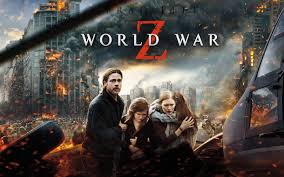
World War Z


Now I wouldn’t normally be drawn to a zombie movie.  Honest.  But this is the Glasgow Zombie Movie , the one where George Square and its environs were used to film scenes of violence, mayhem and panic.  So a bit of a disconnect there, but apparently in the time the film-makers were there millions and millions and millions were poured into the local economy, and locals got to play the part of the zombies.  We’ve heard all the jokes about that so let’s get on with the film.

It’s actually very good.  For some reason, and we are never told why, millions of people have been infected with a virus which is passed on by biting.  They are uncontrollably aggressive and are capable of overcoming the best efforts of armies all over the world.    It largely avoids the ‘yuk’ factor so prominent in most zombie movies and brings a heightened sense of the helplessness of humanity when faced with nature at its most red in tooth and claw.  

At one point a scientist likens nature to a serial killer who has a powerful urge to get caught, and at her strongest sometimes reveals where she is most weak.  Whether this happens, you will have to find out yourself.  

Brad Pitt is great as Gerry Lane, no Man Of Steel, but courageous, sensitive and insightful.  There are no other big name stars but they all work together to produce a tense, quality entertainment.  

Tuesday, 18 June 2013

Man Of Steel


The Glasgow premiere of the first Christopher Reeve ‘Superman’ movie was on a Thursday night in 1978 at the Regal Cinema in Sauchiehall Street.  I was there with my wife of three months.  We cheered - at least I did - when Clark Kent  ripped open his shirt to reveal the famous ‘S’; we chuckled - at least I got the joke - when he decided not to get changed in a perspex telephone booth; and our hearts soared - and I think the ‘we’ is appropriate this time - with John Williams’ majestic music.

And here lies the problem with this attempt to tell the old story in a new way.  It just doesn’t touch you at any level.  It was a good idea to tell something of the Krypton back-story and the circumstances which bring Kal-El to the earth but it goes on too long.  We learn about Clark’s early life in flashback and the problems he had coming to terms with his special powers and his alien identity.  This was promising but we didn’t get enough of it.   What we get more than enough of for the last third of the film are migraine-inducing special effects: buildings imploding and exploding, roads being ploughed up, fearsome weapons bringing death and destruction.  I was glad I went to the 2-D version.   

No cheers, no chuckles, no triumphal chords.  One thing though.  From my first encounter with her in a DC comic I have always thought Lois Lane to be a pain.  Amy Adams has made me think again.  

Friday, 14 June 2013

The Kid With A Bike


Having missed this when it was running in the cinemas I was grateful for the chance to see it on BBC 4 last Sunday.  

It’s a very simple story in many ways about Cyril, a boy in care, and his attempts to connect with his father.  The film opens with Cyril on the phone to his father but continually getting the message that the number has been disconnected.  His father has moved away but not told Cyril or the care authorities.    What’s worse Cyril eventually discovers that his father has sold his precious bike.

When eventually Cyril finds his father working in a restaurant he is told that things have moved on, there has been a new beginning and Cyril should not attempt to contact his father again.  Cyril then turns to a local hairdresser Samantha  who is willing to care for him at the  weekends and later takes him into foster care.  This is done at considerable sacrifice since her boyfriend does not approve and later Cyril tests Samantha to the limit when he becomes involved in a robbery at a local newsagent.  Her perseverance proves to be the turning point in Cyril’s life.  

All through the story the bike is a constant.  It is sold, damaged, stolen, used to lead Cyril astray but in the end it is a symbol of his resilience and his commitment to move on.  

Compassion, redemption, hope.  It’s all there.  And great performances from all involved, especially Thomas Doret as Cyril. 

Saturday, 8 June 2013

In Praise Of Bibliomania!

I have written about this pathological condition before and its problems.  This morning, however, I had cause to bless my compulsive hoarding of books.  A book I had not opened in over a decade and seemed destined for the charity shop gifted me with an insight which has been invaluable for a sermon which will be delivered tomorrow.  I don't know much about Otto Borchert but I am grateful that in 1933 an English translation was made of his work: 'The Original Jesus.'

Make every book a prisoner and in time it will disclose its riches.